

SprintPCB Wraps Up the Global Sources Fall Show with New Global Partnerships
SprintPCB wraps up the 2026 Global Sources Fall Show with 49 prospective
When Unitree’s G1 humanoid robot performed martial arts on the stage of China’s Spring Festival Gala, many viewers saw for the first time how agile and powerful humanoid robots have become.
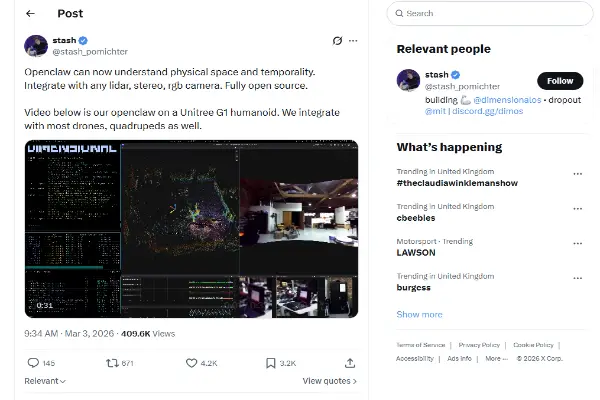
Shortly after that performance captured global attention, another technological development emerged: researchers integrated the Open Claw open-source framework with the Unitree G1 robot. This integration allows the robot to gain stronger environmental perception and memory capabilities, marking an important step toward more intelligent robotic systems.
In just a few years, humanoid robots have rapidly evolved from laboratory demonstrations to real-world applications in industry and public services. Behind these breakthroughs lies not only innovation from robotics companies, but also the support of the entire technology supply chain—including a critical but often overlooked component: Fabrication de circuits imprimés.
Compared with earlier demonstrations, the latest generation of humanoid robots is showing significant improvements in both mobility and intelligence.
The Unitree G1 is a representative example of China’s new generation of humanoid robots:
Height: approximately 130 cm
Weight: around 35 kg
Equipped with 3D LiDAR and depth cameras
23 joint motors enabling highly flexible movement
Maximum knee torque of about 90 Nm
Walking speed of up to 2 m/s
The robot also integrates Unitree’s self-developed UnifoLM large model, enabling it to learn and refine complex movements.
From public commercial release in 2025 to completing a 130,000-step autonomous walking challenge in extreme cold environments, and eventually appearing on a national television stage, the G1 demonstrates how quickly humanoid robotics technology is advancing.
With the integration of Open Claw, robots are moving beyond simply executing pre-programmed commands. The framework builds a joint spatial-temporal-semantic memory system that allows robots to:
recognize objects in their environment
track human behavior patterns
remember their own movement trajectories
In other words, robots are evolving from “following instructions” to “understanding their surroundings.”
The momentum behind robotics is not limited to demonstrations.
According to industry data, global humanoid robot shipments reached about 18,000 units in 2025, representing growth of more than 500% year-on-year.
China has become a particularly active hub for robotics innovation. Today, more than 150 companies are involved in humanoid robot development.
As robots expand into industrial manufacturing, public services, and commercial applications, the demand for reliable hardware infrastructure is increasing rapidly.
This is where PCB technology becomes essential.
If we compare a robot system to the human body:
AI algorithms function as the brain
motion control systems act as the cerebellum
mechanical structures form the body
and PCBs serve as the nervous system connecting everything together
Key robot components—including LiDAR sensors, depth cameras, motor control systems, and high-performance computing modules—all rely on PCBs for signal transmission and hardware integration.
In industrial environments, robots must operate continuously while maintaining high precision and stability. This places extremely high requirements on PCB reliability, durability, and manufacturing quality.
As the robotics industry continues to grow, reliable PCB manufacturing becomes increasingly important.
Shenzhen SprintPCB CO., LTD., a professional PCB manufacturer with its own production facilities, provides high-reliability PCB solutions suitable for demanding technology sectors—including robotics.
SprintPCB has obtained multiple international certifications, including:
ISO 9001 quality management system
AS9100D aerospace quality certification
IATF 16949 automotive industry certification
The company also holds more than 50 patents, ensuring strong technical capabilities and product reliability.
These certifications and technologies enable SprintPCB products to perform reliably in challenging environments such as high temperatures, low temperatures, and continuous vibration conditions, which are common in robotics applications.
From industrial PLC control systems to AI computing modules in humanoid robots, PCBs play a crucial role in enabling stable operation and efficient system integration.
Despite rapid progress, the robotics industry still faces several challenges before large-scale adoption becomes reality.
One challenge is application complexity. Industrial environments require millimeter-level precision, while consumer scenarios demand high safety and advanced interaction capabilities.
Another issue is the lack of unified testing standards and data systems, making large-scale deployment more difficult.
Technologies such as Open Claw are promising, but they still require continuous development and optimization.
Achieving widespread adoption will require collaboration across the entire industry—from AI platforms and software frameworks to core hardware components such as PCBs.
A common concern is whether robots will replace human workers.
In reality, robots currently cover only 20–30% of industrial tasks, mainly in areas that involve dangerous, repetitive, or physically demanding work.
At the same time, the robotics industry is creating entirely new jobs, including:
robot system development
operation and maintenance
AI training and scenario development
The future workplace will likely involve human-robot collaboration rather than replacement.
From science fiction to reality, people have long imagined robots as helpful partners—from TARS in Interstellar to WALL-E.
Today’s robotics industry is steadily moving toward that vision.
Humanoid robots are now at a crucial turning point—from technology demonstration to real-world deployment.
Breakthroughs from innovative companies, combined with strong supply chains—including reliable PCB manufacturing—are helping make large-scale robotic applications possible.
And companies across the ecosystem—from robotics pioneers to manufacturing partners like Shenzhen SprintPCB CO., LTD.—are contributing to the next chapter of this technological transformation.
SprintPCB wraps up the 2026 Global Sources Fall Show with 49 prospective
Discover how SprintPCB celebrates Mid-Autumn Festival with mooncake gifts and a festive
SprintPCB’s 2026 Mid-Autumn Festival and National Day holiday schedule, including order processing
Get quote, solution or any question, Andre always here to help