

Heat Dissipation Challenges and Solutions in PCB Circuit Board Design
Circuit boards are more than just that green board in a phone
Every time I see those circuit board designs that tout high-power applications, I can’t help but wonder if many people are overcomplicating the issue. We always discuss various complex heat dissipation solutions and material choices, but we overlook one of the most basic things: understanding current itself.
Current is not just a numerical parameter. When you try to handle excessive current on a standard PCB, you’ll find every trace on the board warning you. I’ve seen too many design failures stemming from underestimating this fundamental issue. Sometimes, the problem lies in a seemingly insignificant solder joint.
What truly made me rethink this issue was a real-world project experience. We needed to design a high-power PCB that could operate stably, and initially, the team focused on choosing the heatsink and fan. However, during testing, we discovered that the weakest link was actually the solder joints that carried the high current.
That experience taught me a valuable lesson—the core of high-current PCB design isn’t pursuing extreme heat dissipation efficiency, but rather achieving a balanced current distribution across the entire board. When you pile too much current onto a single trace, even if the rest of the design is perfect, the entire system will crash due to localized overheating.
Interestingly, I’ve found that many designers rely too heavily on theoretical values from software simulations. Simulations can indeed help predict temperature rise and voltage drop, but these data often ignore the dynamic changes in real-world applications. For example, when the ambient temperature suddenly rises or the load fluctuates, traces that initially seemed safe can instantly become bottlenecks.
I now prefer to consider redundancy in current paths early in the design process. This doesn’t mean simply widening the traces, but rather providing multiple parallel paths for critical paths. This way, even if one path fails, the overall system can still function. This shift in thinking has significantly improved our project success rate.
Ultimately, solving high-power PCB problems doesn’t require more advanced materials or more complex heat dissipation solutions, but rather a deep understanding of the nature of current and continuous attention to detail. Sometimes, the simplest solution is the most effective.
Many people start by focusing on stacking components when designing high-power PCBs, which is a wrong approach. I’ve seen many designs using 4oz or even thicker copper foil, only to overheat due to improper layout. The real key is understanding how current flows and where heat dissipates.
I remember once debugging a high-power board where, despite using 2oz of copper, one MOSFET was so hot it could fry an egg. It turned out the problem was in the electroplating process; uneven copper thickness on the via walls caused localized resistance spikes. This lesson taught me that simply looking at copper foil thickness isn’t enough; the quality of each step in the process is crucial.
Now, when designing high-current PCBs, I pay more attention to overall thermal management. For example, I distribute high-power components rather than clustering them together. Sometimes, I even intentionally leave gaps for airflow, which is far more effective than simply increasing copper thickness.
Regarding etching, thick copper does present challenges. However, I don’t think it’s necessary to blindly pursue the thickest possible thickness; 2oz or 3oz with good wiring design is often sufficient. The key is to ensure the conductor width is wide enough to carry current while allowing for a safety margin.
Electroplating quality is an easily overlooked crucial factor. Some manufacturers shorten plating time to reduce costs, resulting in insufficient copper thickness on the hole walls. Such boards might pass short-term tests, but they are prone to failure under long-term high-current operation.
When choosing a substrate, I prefer a balanced approach. Ultra-high Tg materials are certainly desirable, but they also increase cost and processing difficulty. Unless for extreme environments, general industrial-grade high Tg substrates are generally reliable enough.
Finally, I want to say that designing high-power PCBs shouldn’t be based solely on specifications. The truly important thing is to understand how the entire system works, considering everything from current paths to heat dissipation. Sometimes, the simplest layout adjustments are more effective than complex process upgrades.
My current practice is to run a thermal analysis using simulation software first, and then decide on the specific process technology. This controls costs while ensuring reliability—a lesson learned from years of experience.
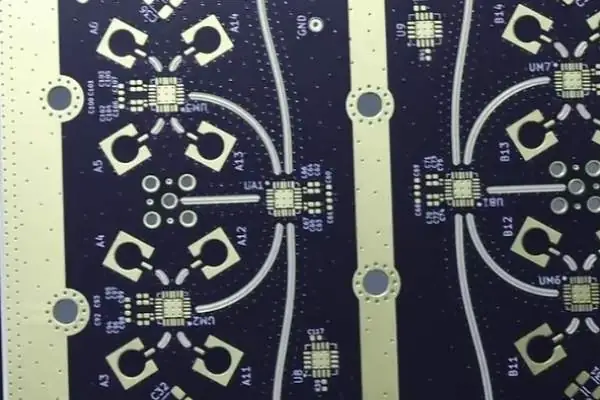
I’ve been pondering high-current PCB design lately, and it’s quite interesting. Many people, when they think of high-power PCBs, immediately think of widening and thickening traces to handle greater current. But the reality is often much more complex.
I remember once discovering a strange phenomenon while debugging a power module: although the trace width, designed according to conventional experience, should have been sufficient to handle the operating current, the temperature rise in certain areas was uncontrollable during actual operation. Later, I discovered the problem was the thermal coupling effect of adjacent signal lines. Those seemingly unrelated small signal traces were actually subtly affecting the overall board’s heat dissipation performance.
This made me realize that when designing this type of circuit, you can’t just focus on the current-carrying capacity of a single conductor; you also need to consider the overall heat distribution of the board. Sometimes, slightly adjusting the component layout or changing the copper-clad area can be much more effective than simply thickening the traces.
Speaking of temperature rise control, I think many engineers rely too much on the calculation formulas in standards. In reality, every project is different. For example, the temperature rise generated by the same current in a confined space is completely different from that in a well-ventilated environment, not to mention the differences in heat conduction between different board materials.
I prefer to run simulation software several times before actual prototyping to check the hotspot distribution. Although the simulation results can’t be 100% accurate, they can at least help us avoid some obvious pitfalls, especially in areas prone to localized high temperatures. Preparing countermeasures in advance is really important.
Regarding IPC standards, my view is that while they do provide a good basic framework, specific applications still need to be flexibly adjusted according to the actual situation. After all, standards are static, but projects are dynamic. Take the high-power PCB we worked on last time, for example. If we designed it strictly according to the recommended values in the standard, the board size would have to be one-third larger than it is now, which obviously doesn’t meet the miniaturization requirements of the product.
High-current design actually tests one’s attention to detail. For example, improper arrangement of the number and placement of vias can not only affect the current path but also potentially become a new heat source. Also, the copper foil thickness is crucial; too thick and the cost becomes prohibitive, too thin and reliability becomes a concern. A balance must be found between design and actual requirements.
I’ve developed a habit of comparing and analyzing measured data and simulation results after completing each high-current project, gradually building my own experience database. This way, I’m more confident when encountering similar projects in the future. After all, practical knowledge is far more reliable than theoretical knowledge.
When it comes to high-power circuits, sometimes you really have to rethink the problem from the most basic level.
I’ve seen too many people immediately get bogged down in choosing special materials, neglecting the simplest physical laws.
I remember once debugging a motor driver board; the heat it generated was terrifying.
Initially, I considered switching to a more advanced substrate material, but later I realized the problem actually lay in the most basic trace width.
Widening those hair-thin power lines to a sufficient size immediately reduced the temperature by more than ten degrees Celsius.
When it comes to high-current PCB design, many people fall into a misconception: they always think that only the most expensive materials can solve the problem.
In fact, ordinary FR-4 board can also perform well in certain situations; the key is to provide sufficient current flow path.
Just like city traffic, even the best road surface can’t withstand lanes that are too narrow.
I once tested the effect of different copper foil thicknesses on heat dissipation, and the results were particularly interesting.
A 2-ounce copper foil was much more effective than a 1-ounce one, but the improvement became less significant when increasing to 4 ounces.
This illustrates that everything has a critical point; beyond that point, further investment becomes counterproductive.
Currently, the market offers a dazzling array of specialty substrates; aluminum substrates and ceramic substrates each have their advantages.
But what’s truly important is understanding their respective application scenarios.
For example, aluminum substrates are very suitable for LED light strips because they need to quickly conduct heat to the entire lamp housing.
However, certain high-frequency circuits may require ceramic substrates. I think the most easily overlooked aspect of designing high-power PCBs is airflow.
Even the best heat dissipation design can’t withstand being confined in a sealed space.
Once, I helped a friend modify a power module; simply adjusting the internal airflow direction lowered the temperature by nearly twenty degrees Celsius.
Sometimes, the solution to a problem is that simple and direct.
Now, I prefer to simulate before implementing designs, as burning out a board is quite costly.
But simulation is one thing, actual testing is always essential.
Even the most advanced simulation software can’t simulate all real-world situations, especially unexpected electromagnetic interference issues.
Ultimately, engineering is about finding a balance between these two.
Whenever I see discussions about high-power PCB design, some people overcomplicate things. The key to handling high current is understanding how the current flows, not obsessing over formulas. I’ve encountered many engineers who immediately get bogged down in the relationship between copper thickness and cross-sectional area, which is certainly important, but what truly determines success or failure are often the easily overlooked details.
Many people believe that inner layers, handling high currents, are riskier and have poorer heat dissipation than outer layers. I think this is a misconception. The advantage of inner layers lies in their ability to provide a more stable current path, especially when you need to run wide traces. While outer layers offer slightly better heat dissipation, they are more susceptible to environmental influences and experience significant temperature fluctuations.
I worked on a project using 3oz copper thickness. Someone on the team insisted on placing all high-power circuitry on the outer layers. During testing, we found that excessive temperature variations caused system instability. Later, we moved some critical paths to the inner layers with ample ventilation holes, and the results were much better. This made me realize that the enclosed environment of inner layers can actually be an advantage in some situations.
The biggest fear in high-power PCB design is localized overheating. Many people only focus on trace width but neglect via design. Imagine a wide trace connected to other layers using only two or three small-diameter vias; those vias will become a bottleneck. I prefer to densely place vias along the current path, sometimes even using combinations of vias of different sizes to distribute thermal stress.
Regarding the calculation of cross-sectional area, I don’t think it’s necessary to be too dogmatic. Some people insist on using standard formulas to calculate to two decimal places. In practical applications, leaving sufficient margin is more important than precise calculation. I usually estimate the trace width based on experience first and then adjust it through actual testing; this is more reliable.
Another common mistake is relying too much on software simulations. The results given by software are often based on ideal conditions, while in actual PCB manufacturing, the copper foil thickness will deviate, and the thermal conductivity of the dielectric material is unstable. Therefore, I always recommend prototyping and measuring data before final design. Once, the simulation showed no problems, but during actual testing, the temperature rise in a certain area exceeded expectations because the actual thickness of the inner copper foil was slightly thinner than the nominal value.
I think designing high-current PCBs is like cooking. Having good ingredients isn’t enough; you also need to know how to combine them and control the heat. The same principles can produce vastly different results depending on the person designing them. The key lies in the control of details and the understanding of actual conditions, rather than blindly applying theory.
Seeing many devices now pursuing miniaturization and high power output reminds me of the many pitfalls I encountered when I first started designing high-power PCBs. At the time, I always thought that simply thickening the copper foil would solve the problem, but I later realized that current carrying capacity is actually a systemic engineering issue. Once, a power module I designed suddenly started smoking during testing. Upon disassembly, I found that although the main line was wide enough, a sharp angle at a bend caused localized overheating. This lesson taught me that handling high current is like managing a flood; you need to consider not only the width of the channel but also the direction of the flow.
Now, when designing high-current PCBs, I pay more attention to overall thermal management. For example, in my recent electric vehicle charging module, although I used a sufficiently thick copper layer to handle the high current, the real challenge was how to quickly conduct the heat away. I tried embedding copper blocks directly under the power devices for heat dissipation, and the effect was much better than simply increasing the copper area. Sometimes, seemingly simple design details are the most critical; for example, the connection method between pads and traces can significantly affect current carrying capacity.
As power density continues to increase, I feel that material selection has become particularly important. Ordinary FR4 board is prone to deformation at high temperatures; I once encountered a board warping during aging tests. Later, I switched to a metal substrate and discovered that the design of the heat dissipation path was more critical than simply pursuing high current capacity. Seeing some colleagues still using standard boards for high-power designs to save costs makes me feel they’re underestimating the long-term reliability risks.
The key to this type of design is a holistic approach. You can’t just look at the current parameters; you also need to consider seemingly unrelated but closely connected factors like mechanical strength and insulation performance. Recently, I helped a friend modify an industrial power supply PCB and found that while the current carrying capacity met the requirements, the poorly designed mounting holes caused solder joints to crack under vibration. A good high-power design should be like a well-designed traffic system, ensuring both smooth main roads and efficient use of each ramp.
Every time I see PCBs in high-power equipment, I wonder, can this thing really withstand the load? Especially high-current PCB designs; just looking at the parameters makes it seem risky. I’ve seen many colleagues design extremely dense circuitry in pursuit of performance, only to encounter problems when high currents are applied.
The most crucial aspect of handling high-power PCBs is leaving enough headroom for the current. Like a water pipe, if the water flow is too rapid and the pipe is too narrow, it will burst. I have a habit of intentionally increasing trace width in critical locations. Some people think this is a waste of space, but compared to frequent repairs later, this small amount of space is negligible.
Pad design is also crucial, especially for connections that need to withstand high currents. I’ve found many designs to be too conservative here. I remember once testing a power module where insufficient pad area led to excessive contact resistance. Doubling the pad size immediately reduced the temperature rise.
Speaking of heat dissipation, I think many people overlook the importance of airflow. Once, adding a heatsink to a high-power PCB had little effect; later, adjusting the component layout to create ventilation channels resulted in a temperature drop of over ten degrees Celsius.
I pay particular attention to the smoothness of current paths when routing. I’ve seen too many designs prioritize aesthetics by making the traces meander, which is a disaster on high-power PCBs. Current is like traffic flow; the more bends, the slower the speed and the greater the resistance.
A recent project I’ve been working on has given me a new understanding of multilayer boards. I initially thought that more layers meant worse heat dissipation, but I’ve discovered that proper planning of the interlayer connections can actually create effective heat dissipation channels. However, this does place higher demands on the manufacturing process.
I think the biggest mistake in high-current design is blindly applying theory. Every project is different, and lab data often becomes significantly less reliable in real-world environments. Now, for every new project, I conduct physical testing first, even if it takes more time.
Sometimes, looking at those high-power PCBs running smoothly is quite amazing. The sense of accomplishment from seeing such a board smoothly handle such a large current for years without problems is stronger than anything else.
Recently, while debugging a high-power PCB, I encountered a rather interesting phenomenon—despite calculating the current-carrying capacity of the trace widths, it consistently overheated abnormally in a certain area. Later, after placing the board under a thermal imager, I discovered the problem wasn’t on the main power supply lines, but rather an inconspicuous cluster of vias. These densely packed vias, like a string of candied hawthorns, lined the current path, and the edges of the copper foil cut off by each via were quietly heating up.
This experience made me realize that high-current design is far more complex than simply choosing trace widths from a table. A conductor’s true current-carrying capacity depends on its narrowest bottleneck, just as a water pipe’s flow rate depends on its thinnest thread. Sometimes, to make room for signal lines, we unintentionally drill a row of vias on power lines, actually creating dozens of tiny heat spots. I once measured an array of vias carrying 30 amps, and the temperature difference was 8 degrees Celsius higher than a 5mm wide trace next to it.
Many people get hung up on whether to use 2 ounces or 4 ounces of copper thickness, but overlook a more crucial factor—current density distribution. I’ve seen people design the copper plating of high-power PCBs as a branching tree, resulting in the current density at the branch tips being more than three times that of the trunk. This design might not show problems in static testing, but once a pulse current is encountered, hot spots will appear first in the edge areas.
The best approach is to keep the current path as uniformly wide as a river’s main channel; sudden narrowing or branching becomes a breeding ground for energy loss.
Speaking of losses, an easily overlooked point is the surface roughness of the copper foil. High-frequency currents tend to flow towards the surface of conductors, and the microscopic undulations of rolled copper act like speed bumps, hindering electron movement.
I’ve tested different manufacturers’ substrates with the same linewidth, and at switching frequencies of hundreds of kilohertz, the loss difference can reach 15%.
This doesn’t even account for DC resistance.
Recently, while working on a power tool controller, I also discovered a phenomenon—the magnetic field of a high-current loop can strangely couple with nearby inductors.
Once, during layout, I placed the sampling resistor’s trace parallel to the MOSFET, and the magnetic field changes during each switch induced glitches at the sampling end.
This was only resolved by changing to perpendicular cross-tracing. This invisible energy interaction is more elusive than simple Joule heating.
Mastering high-power PCBs is a bit like cooking; you can’t just follow a recipe, you need to understand the path of heat transfer. The calculation formulas in those textbooks can only guarantee that the wok will not explode; true stability comes from intuition about the trajectory of energy flow.
Circuit boards are more than just that green board in a phone
From disassembling old routers to visiting electronics manufacturing plants, I gradually realized
As an electronics enthusiast, I’ve come to understand firsthand the impact of
• Expert in Small-to-Medium Batch Production
• High-Precision PCB Fabrication & Automated Assembly
• Reliable Partner for OEM/ODM Electronic Projects
Business Hours: (Mon-Sat) From 9:00 To 18:30