

Why the Best PCB Supply Chains Are Built Like Relationships, Not Transactions: Lessons for Satellite Communication PCB Programs
What actually makes a long-term PCB supply chain partnership work — shared
I often feel that discussions about data center technology upgrades are trapped in a misconception—that upgrading server chips alone solves everything. The real bottleneck is often in the unassuming interconnects. For example, in a recent project, our team invested heavily in a new GPU cluster to boost model training efficiency. However, we found that data transfer speeds couldn’t keep up with processing needs. The bottleneck was in the optical modules handling signal conversion.
The heart of these modules is a small multi-layer printed circuit board. It may sound simple—just a few layers of copper traces. But when you need to process hundreds of Gbps of data, every trace and via on this board becomes critical. I recall a test where a slight impedance mismatch on a PCB caused a spike in bit error rate for an entire link, directly affecting the accuracy of training results. For instance, in a 112Gbps PAM4 signal system, a micron-level deviation in trace width or an uneven dielectric thickness can cause severe signal reflections and attenuation, making it impossible for the receiver to correctly parse the data. It’s like a subtle bump on a highway causing a vehicle to lose control.
Many vendors promote their advanced materials or precision processes, but I believe the real key is a paradigm shift in design philosophy. Traditional multi-layer board design focused mainly on electrical connectivity. In high-speed data transmission, we need to prioritize signal integrity and thermal management. As AI models grow, with single compute nodes processing exponentially more data, these subtle design differences become critical. This requires using full-wave electromagnetic field simulations to pre-analyze crosstalk and losses, rather than relying on past rule-of-thumb guidelines.
I’ve seen teams try to cut costs by using conventional materials on PCBs for fiber optic equipment. The system would overheat under load, requiring additional cooling measures and increasing overall energy consumption. Good design anticipates these factors from the start: selecting substrate materials with a more stable dielectric constant, optimizing the power distribution network, and even allowing for thermal expansion during the layout phase. While low-loss materials like MEGTRON or Tachyon have a higher unit cost, their stable electrical properties can reduce the complexity of signal conditioning circuits, making them more economical from a system perspective.
I recall visiting a factory last year specializing in multi-layer boards for high-speed optical communications. The workshop was almost fully automated, but engineers spent significant time on quality assurance, verifying the performance consistency of each batch. This highlighted that while manufacturing precision is crucial, process control and quality systems are the keys to product reliability. They perform vector network analysis for insertion and return loss on every board and create detailed “digital twin” records to ensure performance stays within strict limits.
Many may not realize that when we discuss AI compute power, a significant portion of energy is consumed by data transfer, not the computation itself. Optimizing these interconnects can boost performance and cut operational costs significantly, often more effectively than simply chasing higher chip compute. Studies show that in hyperscale data centers, power consumption for data movement can exceed 30% of the total, making the ROI for improving interconnect efficiency very high.
In the coming years, as real-time data processing demands increase, we will see a new wave of innovation in optical communication hardware. This won’t just be about materials and processes but also about designing new methods and validation workflows, because at near-light-speed data rates, even tiny delays are magnified. For instance, silicon photonics integrates optical and electrical components on a single chip, potentially eliminating electrical interconnect bottlenecks, but it requires the PCB to act as a complex heterogeneous integration carrier.
I’ve always felt that many people misunderstand the circuit boards in fiber optic communications. They get caught up in buzzwords like high-precision technology and market trends. It’s not that complex. I have been in this industry for a while, starting with relatively simple multi-layer printed circuit boards for standard network switches. Later, I moved into fiber optic equipment and noticed an interesting phenomenon: everyone focuses on the latest trends like 1.6T optical modules, as if the entire industry depends on them. That’s not the case.
The real backbone of the network is often the less glamorous transmission and switching equipment boards. They may not need to push data rates to the absolute limit, but their stability and reliability requirements are incredibly high. Imagine a city’s backbone network node failing due to a faulty board. That would cause far more disruption than swapping a few high-speed modules in a data center.
So, I think many discussions miss the point. The competition is about who can build higher-layer boards and use more advanced materials, as if a board with less than 18 layers isn’t worth mentioning. For most practical applications, a well-designed, robust 12-layer or even 10-layer board can meet the requirements perfectly, with better cost control and higher yields. I have seen too many cases of over-design for the sake of impressive specs, leading to cost overruns or reliability issues. In product design, especially for industrial-grade equipment, the art of balance is more important than extreme material stacking.
For instance, in a metro network upgrade project, the client initially wanted the latest and most expensive solution. However, after analyzing their traffic model and growth projections, we recommended a more mature design focusing on power integrity and thermal management, rather than blindly chasing higher signal rates. The result? The system ran stably for years without major issues, while some “advanced” competitor solutions ran into trouble due to their aggressive designs.
This isn’t to say innovation isn’t important; it is. But we must apply it in the right context. Many vendors are rushing into the high-end optical module market, but underinvesting in critical areas like backplane connectors and power management PCBs. This seems to put the cart before the horse. A good fiber optic communication system is a whole, where every PCB plays a vital role—from the core optoelectronic conversion module to the large-scale routing equipment that directs traffic. Neglecting the design and quality of any one component will compromise the entire system’s performance.
My view is simple: don’t be swayed by impressive-sounding numbers and concepts. Focus on building every board, regardless of its application, to be solid and reliable. That’s what truly matters and is what the market ultimately rewards.
I was chatting with a hardware designer friend recently about a phenomenon: many people think the multi-layer PCBs used in fiber optic equipment are just ordinary boards with more layers. This is quite misleading. My experience with these projects tells me a completely different story.
Take fundamental signal transmission, for example. While signal integrity is important for consumer electronics, high-speed fiber optic communication presents a completely different level of challenge. The design focus shifts entirely; it’s no longer just about ensuring connectivity. I’ve seen teams that didn’t take impedance control seriously and paid the price. They followed standard routing guidelines, but the boards couldn’t work stably at high speeds. Signal reflections were terrible, and the BER was unacceptably high. They eventually realized that in these high-speed scenarios, even a tiny impedance deviation could severely degrade performance.
Now, when working on such multi-layer boards, we spend significant effort simulating and validating signal paths. The width, spacing, and routing of every via and trace are adjusted repeatedly until the impedance characteristics of the entire channel meet our targets.
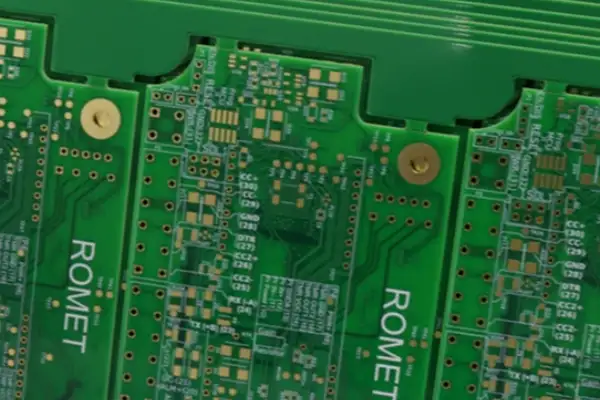
Thermal management is another often overlooked area. Highly integrated communication modules generate significant heat, especially when packed into a small space and running continuously. I recall testing a sample board that quickly felt hot to the touch; after prolonged operation, some areas reached alarmingly high temperatures. We had to re-evaluate the entire layout, spreading out high-power components and planning thermal paths within the board. Sometimes, special metal-core substrates or embedded heat sinks are needed to dissipate the heat effectively.
This reminds me that a good PCB for fiber optic equipment is like a precision balancing act, requiring a trade-off between electrical performance, mechanical strength, and thermal management. A failure in any one area can render the product useless. Material selection is another critical factor. Standard FR4 is often insufficient for high-frequency, low-loss transmission. We frequently need to find specialty materials with more stable dielectric constants and lower loss tangents. These materials are more expensive and harder to process, but this investment is often unavoidable.
So, a seemingly simple multi-layer board requires consideration of many factors, from signal purity to system reliability. No detail can be overlooked, which is why this field has such a high technical barrier. Without sufficient experience and deep understanding, creating a truly reliable product is difficult.
I recently discovered an interesting phenomenon while studying circuit boards in optical communication equipment. Many people think simply improving chip performance is enough, but that’s not the case. In modern optical modules, everything is packed into a fingernail-sized space. The design of these multi-layer boards is like walking a tightrope. It’s not just about high-speed signal transmission; it’s about managing the heat generated by all those tightly packed layers. I’ve seen designs that, in pursuit of ultimate signal integrity, route traces so densely that chip temperatures rise, degrading the module’s performance. This reminds me of a high-speed optical module I once disassembled. It used a special material optimized for high-frequency signals, which not only had low transmission loss but also efficiently conducted heat away from the chip.
However, even the best material can’t compensate for poor design. Some engineers stack many layers, thinking it improves performance. In reality, more layers create more complex thermal paths, potentially leading to heat islands. I prefer designs that treat critical heat-generating areas specially, like placing large copper pads directly under the chip and using dense arrays of tiny vias to channel heat to a heatsink on the back. These vias, often a fraction of a millimeter in diameter, effectively create a high-speed highway for heat to escape the core area.
Another overlooked aspect is dimensional precision. As optical modules shrink, connector positions must be extremely accurate. A deviation of even a few tens of microns can misalign the optical fiber, degrading signal quality. So, manufacturing these boards requires strict thickness control and surface flatness. It’s a field that demands a perfectionist mindset; every detail must be perfect, or overall performance suffers.
Regarding material selection, there are countless new boards on the market promising low loss or high thermal conductivity. In practice, you often need to find a balance between these properties, as both signal integrity and thermal management are essential. I’ve seen manufacturers chase extreme speed with ultra-low-loss materials, only to neglect cooling, leading to long-term reliability issues. A good design is a comprehensive compromise, not a pursuit of a single metric’s excellence.
I was recently talking to a friend working on a high-speed optical communication project. Their team was designing a new high-speed module and noticed an interesting phenomenon: when discussing performance improvements, they habitually focused on the most advanced materials.
We must admit that top-tier materials like Panasonic M7 or Rogers materials have excellent performance. However, the final performance of a high-speed multi-layer board is often determined by a combination of easily overlooked details. For example, many think choosing low-roughness HVLP copper foil is sufficient. But even subtle variations in the lamination process can alter the surface profile, affecting signal integrity. I’ve seen cases where engineers painstakingly selected ultra-low-loss materials, only to have the dielectric constant fluctuate locally due to poor temperature control during lamination, tightening the loss budget for the entire channel. Such hidden problems are hard to catch in initial testing but often emerge during system integration, causing costly rework.
So, my view might differ. In high-speed fiber optic PCB design, instead of chasing the extreme limits of individual materials, I believe we should focus more on systemic compatibility and process stability. A mature solution knows where to use the best materials and where to use clever design to balance cost and performance. For example, on a loss-sensitive RF link, you might use ultra-low-loss materials and the smoothest copper foil to minimize conductor loss. But on a digital control circuit with less stringent timing, a proven mid-performance material with a multi-layer stack-up could work perfectly, helping to optimize thermal management and structural strength. This hybrid approach is often more practical and better handles mass production variables. After all, even the best material is useless if it can’t be processed reliably.
Ultimately, hardware design, especially in high-speed domains, is not just about assembling parts. It’s the art of finding the optimal solution under various constraints. Every decision is a complex trade-off between performance, cost, and reliability.
I recently chatted with friends in optical communications and noticed that when discussing high-speed PCB design, they keep emphasizing a single point, as if controlling impedance within ±5% is a magic bullet. This seems odd. In the board for fiber optic equipment, is the only “golden rule” this one number? I think it’s more complicated.
What really struck me was a project from last year. We were designing a multi-layer board for a high-speed optical module. A senior engineer kept reminding us not to just focus on the ideal impedance from software simulations. He said we must consider real-world production variations—batch-to-batch material differences, lamination misalignments, and even factory temperature/humidity swings, all of which affect the final product’s performance.
I recall a prototype batch where the eye diagram wasn’t ideal. Everyone first tried adjusting trace width or dielectric thickness to correct the impedance. But we eventually found the problem was slightly higher copper foil roughness on one layer than expected. This seemingly minor parameter became a noise source at high frequencies, reducing signal integrity.
So, for these high-speed applications, chasing a static impedance tolerance is less important than understanding how the entire system works together—from material selection and stack-up design to manufacturing processes—every link in the chain must be considered holistically.
For instance, when choosing a multi-layer material, many prioritize a low loss factor, which is correct. But have you considered that the dielectric constant stability at high frequencies can vary significantly between manufacturers of the same material? Some materials perform perfectly in the lab but drift in mass production due to slight variations in the curing process.
Regarding module design, I find many young engineers over-rely on EDA auto-routing, especially for dense differential pairs. Software can ensure physical length matching, but it cannot judge which path is more susceptible to power plane noise coupling, or which via structure might resonate at a specific frequency. I’ve seen someone spend a week optimizing a trace’s impedance from 99 to 100 ohms while ignoring the electromagnetic leakage from a nearby power split, causing the whole board to fail EMC testing.
Ultimately, designing a PCB for fiber optic equipment is an art of balancing constraints, not just following a few technical rules. You must consider signal integrity, power integrity, thermal management, and manufacturability simultaneously. Sometimes, these requirements conflict. For example, to reduce loss, you want smoother copper foil, but smoother surfaces have lower adhesion, risking delamination during multiple lead-free soldering cycles. Or, adding internal copper planes for better cooling might change the reference plane for adjacent signal layers, affecting their characteristic impedance.
So, instead of obsessing over ±5%, spend more time understanding the chain reaction of your design choices. Before laying out each trace, ask yourself: Why is this trace on this layer? Why this via size? Why is this decoupling cap placed here? When you can answer these questions, you’ll find the “golden rule” is a methodology you’ve refined through practice, not a single number from a textbook.
Every board has a unique application, and client needs are constantly changing. A perfect design today might need adjustment tomorrow. Critical thinking is more important than memorizing rules, especially in our rapidly evolving industry.
I’ve recently noticed a common phenomenon when people discuss PCBs for optical communication equipment: they tend to focus on the most cutting-edge technical specifications, as if failing to mention nanometer precision or hundreds of layers is unprofessional. I think this might miss the point. The factors that truly determine a board’s reliability over years of operation are often found in more fundamental, less glamorous areas.
Take multi-layer boards, for example. The immediate association is HDI, high layer count, and complex routing. That’s not wrong. But many overlook a fundamental aspect: the “multi-layer” structure itself is a major challenge. It’s not just a physical stack; it’s a long “coordination” between different materials and processes. Even minute differences in the coefficient of thermal expansion (CTE) between layers—which are almost inevitable—can accumulate stress over long-term operation and thermal cycling. A well-designed signal path can degrade from this internal “tug-of-war.” For instance, in areas with significant temperature variations between day and night, this thermal stress can cause subtle deformations, potentially leading to changes in connection resistance and even intermittent faults that are hard to reproduce. This failure mode is often slow and insidious, far less obvious than electrical overstress, yet it is a persistent threat to the device’s lifespan.
HDI is almost synonymous with high-end PCBs today. Chasing finer trace widths is necessary to make room for more components. However, I’ve seen designs that push routing to the limit to achieve ultimate density, ignoring current-carrying capacity and thermal paths. It’s like building skyscrapers in a city without widening the main roads or improving drainage. The result is localized overheating and degraded signal integrity. Specifically, when trace cross-sections are too small, DC resistance increases, generating more Joule heat for the same current. Simultaneously, dense routing hinders heat dissipation to the surrounding material and air. Heat trapped in a small area can exceed material or component ratings, alter dielectric properties, and affect the impedance continuity and propagation speed of high-speed signals, ultimately raising the BER.
I’d like to highlight a seemingly traditional but critical aspect of PCBs for fiber optic equipment: surface finish and gold layer quality. Much discussion centers on topics like how small a laser-drilled hole can be—important, yes. But for the gold wire bonding pads on the board? How flat are they? Is the gold layer uniform and dense? These details truly determine if a chip can be reliably “placed” and operate stably over time. If the gold layer has porosity, uneven thickness, or poor adhesion, it can lead to weak or insufficient bonding strength during wire bonding. Under vibration or thermal cycling, these weak points can fail first, causing open circuits. Even a micron-level flatness deviation can affect the angle and arc of the gold wire bond, introducing stress and reducing mechanical reliability.
Sometimes I wonder if we are too superstitious about “new” technology. For instance, mSAP can create very fine traces, which is an advantage. But in demanding reliability applications, the time-tested subtractive process with precise image transfer might offer better adhesion and consistency. The key is understanding the nature of each process, not blindly following trends. mSAP forms traces through chemical deposition and pattern plating, with different sidewall adhesion characteristics than subtractive etching from copper-clad laminates. Under severe thermal shock or mechanical stress, these microstructural differences can affect separation risk. Therefore, process selection must be based on the product’s application environment, expected stress types, and failure consequences, not simply on whether a technology is “new” or “advanced.”
So, my view might be different. I believe a good PCB for fiber optic equipment is more of a balanced work of art. It needs to find the delicate balance between performance and long-term reliability, which requires a deep understanding of the entire system, not just a breakthrough in one technology. Sometimes, a slower, steadier approach that gets the fundamentals right is the way to go further.
I recently chatted with some friends in high-speed communications and noticed a trend: when discussing the manufacturing bottlenecks of high-end optical modules, everyone focuses on the most advanced technical specifications or material science breakthroughs. I think the real bottlenecks are often in the most basic, unassuming areas—like how to manufacture a seemingly ordinary PCB that meets all requirements.
Take multi-layer printed circuit boards, for example. Many think, “it’s just pressing a few boards together, what’s so hard?” But when you have to integrate many complex signal channels on a single board, the alignment accuracy between each layer becomes critical. “A miss is as good as a mile” perfectly applies here. The faster the signal, the higher the requirement for trace flatness. Sometimes you spend a fortune on the latest chip, only to have the entire system’s performance held back by a tiny flaw on the board—that is truly frustrating.
I’ve seen many teams developing new communication modules spend most of their energy on core chip design, neglecting the board that supports it. It’s like a top chef focusing on premium ingredients while ignoring temperature control on the stove. Especially with Chip-on-Board packaging, where you attach the bare die directly to the substrate, the substrate’s stability and precision directly determine the quality of wire bonding and, ultimately, the accuracy of optical coupling. This isn’t just about sticking components on; it’s a process involving multiple steps from placement to calibration, and any failure at any point will ruin the effort.
Speaking of which, many manufacturers are now pursuing so-called fine-line processes. Traditional methods are indeed struggling to meet future high-speed transmission requirements. But rather than blindly pursuing a specific process, we should carefully review our production processes to identify areas for optimization. Can your etching equipment achieve the required precision? Is your process control up to the task? These fundamental aspects often decide the outcome.
An engineer I know once complained that they nearly overhauled their entire production line just to meet a strict impedance tolerance, only to discover the root cause was the initial material selection. This shows that issues are often interconnected; you can’t solve them in isolation. It requires a systemic approach with a global view from design to manufacturing to testing.
Therefore, I believe the challenge for high-end optical communication equipment isn’t just technological breakthroughs, but also engineering capability and supply chain coordination. Can you design a great solution and then consistently manufacture it with consistent quality? That is the real challenge. Companies that persist and get every detail right will be the ones to succeed in the future.
Many think PCB design for fiber optic equipment is just about using high-precision materials. I’ve worked on enough projects to see this is a misconception. There’s a fascinating trend: everyone is chasing smaller micron-level tolerances or more complex layer-count competitions, while often ignoring a fundamental question: can this thing work reliably for over ten years? That is the true test of engineering.
I’ve seen designs using the newest, most expensive materials and stacking them into 10+ layers, resulting in excellent theoretical specs. However, in long-term reliability tests like high-temperature/high-humidity cycling or continuous vibration, problems emerge. Either a solder joint cracks, or inner-layer traces develop micro-cracks from CTE mismatches. These faults are invisible in short-term lab tests.
With multi-layer boards, more layers aren’t necessarily better. You must balance signal and power integrity. Sometimes, in the pursuit of extreme signal transmission, designers fragment the ground plane, making power noise a bigger problem. I prefer complete simulation analysis early on, sacrificing some theoretical performance peaks to ensure stable operation under extreme conditions. For example, for high-speed SerDes channels, in addition to insertion and return loss simulations, a thorough power distribution network (PDN) impedance analysis and simultaneous switching noise (SSN) evaluation are critical to ensure the power rail doesn’t collapse during burst transmission, causing errors.
Regarding reliability verification, the GR-468 standard is an excellent reference framework. But I think it shouldn’t be treated as a checklist. Its core spirit is to build a complete reliability mindset—from material selection to process control, and from design verification to production monitoring. For instance, the mechanical integrity tests aren’t just simple vibration tests; they should simulate all stresses in the real installation environment, including transportation vibration, continuous micro-vibration from cabinet fans, and structural deformation from seasonal temperature changes. These combined stresses are a constant challenge for fragile components like BGA packages and ceramic capacitors.
Regarding protection strategies, many engineers immediately think of potting. Potting provides excellent physical and environmental protection, but it’s not a silver bullet. Once potted, repairs are nearly impossible; and if the material is poorly chosen, curing stress can damage precision components. I prefer a zone-based approach: locally reinforce the optical coupling section, and use a conformal coating with appropriate structural protection for the digital section. For example, in the optical path alignment area of a transceiver, flexible silicone can be locally applied to dampen stress without affecting the thermal dissipation path of the laser and detector.
The true key to a 20-year lifespan for a fiber optic equipment PCB isn’t in flashy specs but in the fundamental process controls: uniform hole wall quality in drilling, consistent and adequate copper plating thickness, and strong solder mask adhesion. For example, rough or pitted via walls can lead to electrical issues and, more critically, become crack initiation points under thermal cycling, ultimately causing interconnect failure. Therefore, strict control of drilling parameters, desmear, and electroless copper deposition steps is essential.
In one project, we revised a seemingly simple grounding design three times. The final version wasn’t the theoretical optimum but the one easiest to manufacture consistently. This proved to be the right decision, as that product batch ran for over eight years with a failure rate far below the industry average. The initial theoretical scheme required a complex partitioned star ground, demanding extremely precise PCB layout and assembly, with any deviation introducing noise. We simplified it to a clear, hierarchical single-point and multi-point mixed grounding system. Though the theoretical ground isolation was slightly lower, its robustness was exceptional, leading to highly consistent performance across production batches.
Ultimately, designing a PCB for fiber optic equipment is like building a house. You can use the most expensive steel and concrete, but if the foundation is flawed, the house won’t last. Truly good design is about finding the best balance between theoretical performance, engineering feasibility, and long-term reliability, not just chasing impressive numbers on paper. This balancing act requires the designer not only to understand circuits and electromagnetic fields but also to have a deep knowledge of material properties, process limits, and the final product’s harsh application environment.
Recently, while talking with friends working on high-speed communications about multi-layer boards in fiber optic equipment, I noticed a trend: people often jump to buzzwords like advanced HDI or laser imaging. That’s not wrong. But I believe the true measure of these boards is whether they can withstand real-world conditions.
I’ve seen too many beautifully designed boards fail in the field. Especially in long-haul fiber optic communication systems, a board might sit in a server room for over a decade. It must endure thermal cycling, resist the slow corrosion of moisture, and survive the bumps of shipping and installation. So, when I evaluate a multi-layer board for fiber optic equipment, my first question is: how do you perform rigorous testing? Not just a simple power-on check, but tests that simulate extreme environments. Can it run for hundreds of hours in high-temperature/high-humidity conditions without issues? Can it survive severe temperature swings from sub-zero to near-boiling? Can it withstand vibrations that simulate field conditions to test solder joints and trace integrity? These tests might sound tedious, but they are critical.
I knew a team that had problems. They designed ultra-fine traces for high-speed signal transmission. After the first production batch shipped, they started experiencing unexplained signal attenuation. After extensive investigation, they found that under specific temperature/humidity conditions, a slight deformation in one layer caused a shift in impedance. From then on, they prioritized environmental reliability testing over performance specs.
Many vendors emphasize their ability to produce multi-layer boards for high-speed optical modules. But the real test is whether they have a complete validation system to ensure these boards aren’t just “capable of being made” but “capable of lasting.” This reflects the control over the entire production process—from raw material batch management and parameter logging for each step to final comprehensive testing—all of which require strict standards and traceable systems. Otherwise, even the most advanced technology can hide defects from an out-of-control process. Ultimately, a good multi-layer board for fiber optic equipment needs not only excellent electrical properties but also physical stability that withstands the test of time.
Many people think PCBs for optical communication equipment are just about more layers and finer lines. I used to think so too, until I got deeply involved in the entire process from design to mass production. The experience that changed my view wasn’t a sophisticated theory, but a seemingly basic aspect of production that truly determines the final product’s performance and reliability.
Take the much-discussed mSAP process. I’ve seen manufacturers produce flashy marketing materials with impressive lab data. But during mass production, their yield fluctuates dramatically. Often, the problem isn’t the equipment or the material, but a lack of process control. Looking at their production line records, many key parameters are just approximate ranges—”stability” is a foreign concept. A truly capable supplier offers not just a few pretty test reports, but a complete set of continuous process capability analyses, showing that every step operates within a controlled range. This is the real demonstration of technical capability, far more substantial than empty talk of “advanced processes.”
Material supply is another issue. The industry is obsessed with materials like M7, M8, or even M9 and HVLP4 copper foil. These are great, but they are often supply chain “luxuries,” not always available when you need them. The most frustrating scenario is when the design is finalized, the production line is ready, and the core material is out of stock, stopping the entire project. So, when evaluating a partner, I look closely at their material supply channels. It’s not just about having a contract with a big material supplier; it’s about whether they have a risk management mechanism. Do they maintain safety stock for these scarce items? Have they validated alternative materials? When supply is tight, do they just wait, or do they have a backup plan to keep production running? These details often reveal a company’s capabilities and vision more than technical specs.
Testing and validation are a whole different competitive dimension. Many PCB manufacturers can perform basic electrical tests. But a far smaller number can accurately test high-speed signals. You claim your board can support 1.6T data rates? Great. Can you provide comprehensive signal integrity data from a real high-frequency environment? For instance, S-parameters from a VNA, particularly insertion and return loss at 10GHz and 20GHz. This can’t be faked with a simple multimeter or oscilloscope.
I’ve seen good practices where they treat the high-speed signal link as a whole system, modeling and measuring from the chip package to the PCB traces to the connector interface. They provide Time-Domain Reflectometry results showing impedance matching, analyze how different stack-up structures affect signal attenuation, and even verify the stability of the material’s dielectric constant across frequencies. This might sound technical and a bit boring, but it’s exactly what makes a high-end multi-layer board “usable” versus “excellent.” A beautifully designed board is worthless if the signal isn’t clean and low-loss. Ultimately, this industry is becoming more refined and specialized. The era of winning just by stacking layers is over. The real barriers are in the invisible process controls, in supply chain management, and in rigorous testing.
Recently, while chatting with some hardware friends, an interesting topic came up: when people think of data center upgrades, they imagine high-end chips or new algorithms. That’s correct, but I noticed they often overlook the underlying physical platform that supports all this computation and connectivity. Take PCBs, for example—they are no longer the simple green boards of the past.
In our quest for higher compute power, we seem fixated on software and architecture optimization, forgetting the fundamental hardware bottlenecks. I’ve seen projects designed beautifully on paper, only to be held back by signal integrity issues in the underlying interconnects. It’s like building a highway but leaving the entrance ramp as a single-lane dirt road—even the best cars can’t get up to speed.
For fiber optic communication equipment, the demands on the PCB are especially high. It’s no longer just about making connections; you must consider the signal’s transmission quality at high frequencies. Standard PCBs often cause significant loss when handling high-speed optical signals, directly impacting the entire system’s efficiency.
I’m increasingly convinced that the ability to design multi-layer printed circuit boards, in a way, determines how far a data center can go. It’s not just about routing traces; it’s like planning a precision city on a microscopic scale. How do you arrange the layers? How do you isolate signals? How do you prevent interference during high-speed data transfer? These accumulated details form a reliable compute foundation.
Think about the massive data exchange between hundreds or thousands of GPUs in modern clusters. It all relies on these physical connections. If the interconnect foundation is flawed, even the most powerful compute units will be bottlenecked. Sometimes we spend a fortune upgrading processors, only to see marginal performance gains, and the problem likely lies here.
The real craftsmanship is often hidden. For example, the specialty materials used in high-speed optical modules must maintain stable performance under various conditions. Does temperature change or frequency increase affect signal transmission? These subtle factors distinguish good design from great design.
Hardware development has never been about single-point breakthroughs. As chips become more powerful, the supporting power delivery, cooling, and interconnects must keep pace. The PCB, as the carrier for all these elements, plays the role of integrator. It must organically combine components of different specs and needs into a cohesive, stable, and efficient whole.
From this perspective, the choice of PCB solution reflects your understanding of the entire system architecture. Do you just want something that works now, or are you planning for future expansion? Are you solely focused on cost, or do you prioritize long-term reliability and performance? These decisions ultimately manifest in the seemingly simple circuit board designs.
In the coming years, as compute demand grows explosively, the requirements for underlying hardware will only increase. Solutions that adeptly manage high-speed signal integrity, complex inter-layer interconnects, and high-density integration will become increasingly valuable. It reminds me of the early internet days, when everyone focused on website design, until they realized server performance and bandwidth were the real bottlenecks. Now, a similar situation: while everyone is fixated on AI models, perhaps we should spend more time ensuring the physical foundation supporting these models is robust.
After all, any grand digital building needs a solid foundation. In our industry, those precisely designed and manufactured PCBs are the most critical part of that foundation.
What actually makes a long-term PCB supply chain partnership work — shared
Practical, experience-based strategies for how to reduce PCB procurement risks — from
Real factory-floor lessons on how to optimize a PCB manufacturing process —
• Expert in Small-to-Medium Batch Production
• High-Precision PCB Fabrication & Automated Assembly
• Reliable Partner for OEM/ODM Electronic Projects
Business Hours: (Mon-Sat) From 9:00 To 18:30
Get quote, solution or any question, Andre always here to help